DISTRICT
A defined catchment.
Build the project around a local waste stream, collection logistics and an identified gas user.
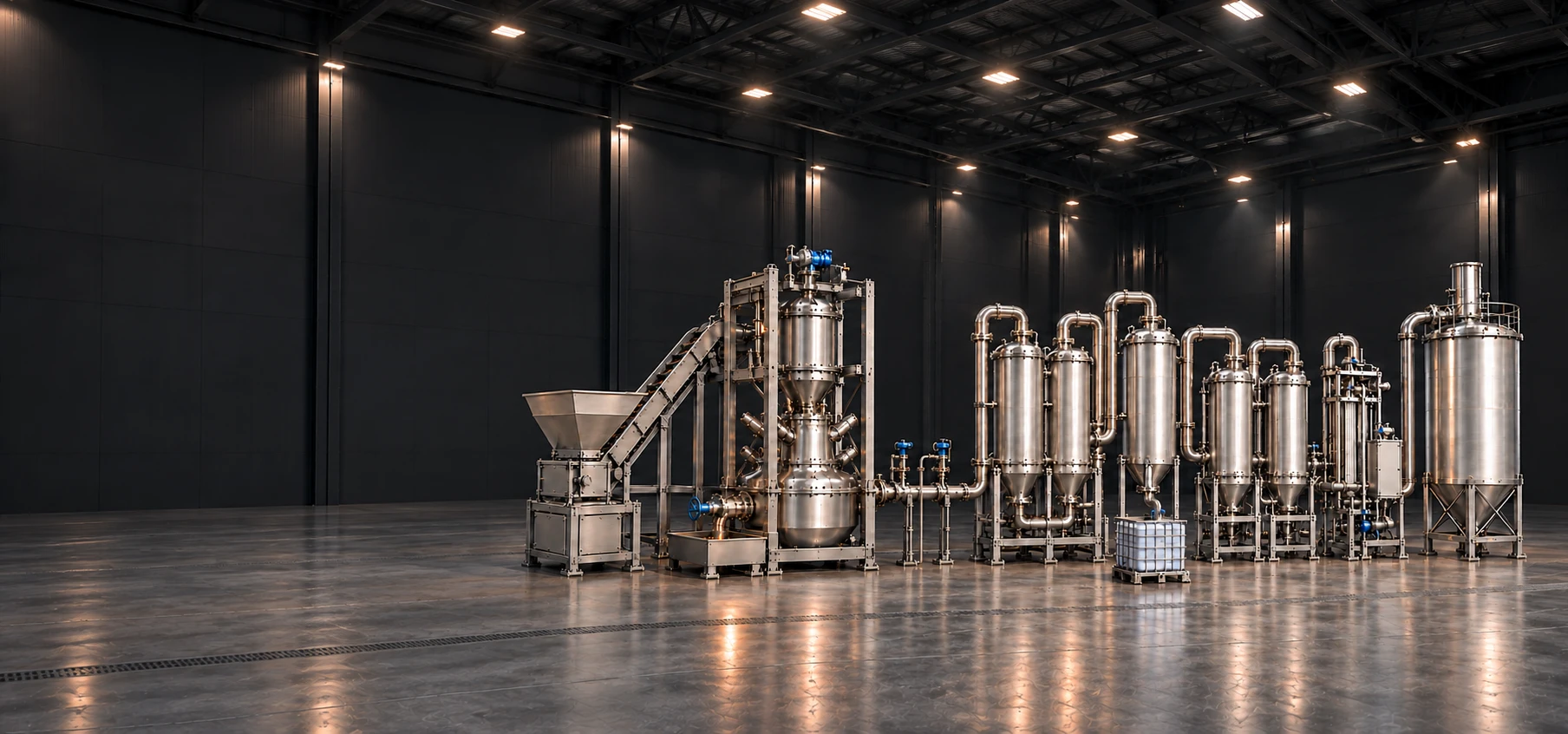
PLASMA CONVERSION TECHNOLOGY
PGMCC combines plasma gasification with catalytic methane production. For waste operators, municipalities and industrial project developers assessing a route for prepared residual municipal waste.
Discuss your project01 / THE INDUSTRIAL OPPORTUNITY
The reference feedstock is municipal solid waste after sorting and preparation. Project assessment considers composition, moisture, contaminants and seasonal variation to define the accepted feedstock and preparation requirements.
The process gasifies the organic fraction, vitrifies minerals, and conditions syngas before water-gas shift and Sabatier methanation. CO₂ absorption with supplied KOH forms potassium carbonate; gas drying and final treatment complete the methane route.
02 / THE TRANSFORMATION
The industrial concept combines methane production, potassium carbonate, vitrified minerals and process-water recovery. This illustration shows a possible site redevelopment; the layout and output routes are defined for each project. Move the divider to compare.
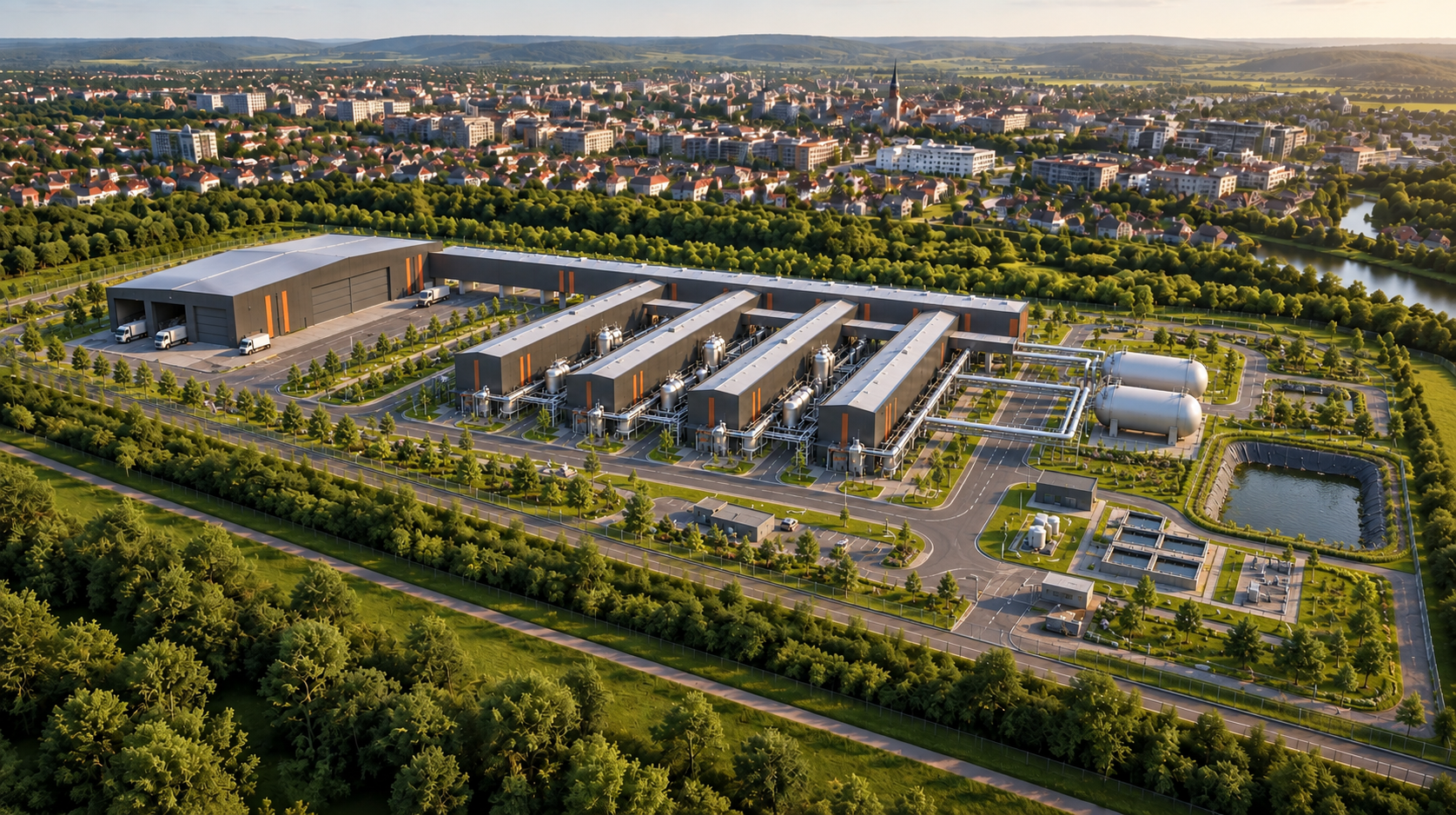
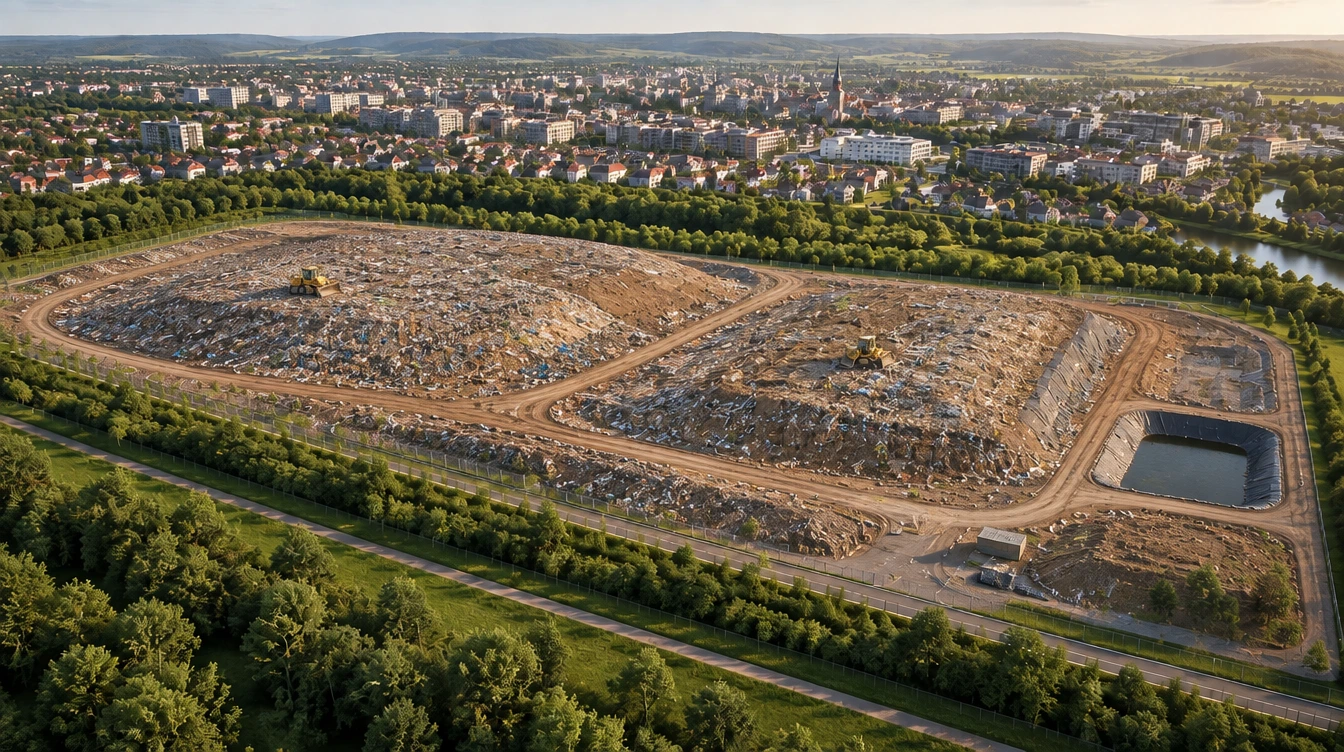
Recover suitable recyclables upstream. Assess prepared residual waste for PGMCC conversion. Define methane use, mineral and chemical output routes, process-water recovery and reuse and the management of remaining residues as one project.
DISTRICT
Build the project around a local waste stream, collection logistics and an identified gas user.
CITY
Explore multiple process lines alongside shared preparation, utilities and output-handling infrastructure.
REGION
Evaluate collection hubs, transport distances and phased capacity across several municipalities.
Landfill redevelopment includes site assessment and remediation planning. Processing capacity and the number of PGMCC lines are selected for the available waste volume and composition. Feedstock testing and site-specific engineering define throughput, recovery targets and output uses.
Plan a municipal projectINDUSTRIAL METHANE CONFIGURATION
The commercial reference design presented on this website is based on a 1,000 kg/h dry-feed industrial module.
Dry MSW design basis
Modelled methane output
Operating-time assumption
At approximately 40% moisture, the model receives 1,666.67 kg/h of wet waste: approximately 13,333 tonnes/year. Modelled methane production is 2,808 tonnes/year.
Fresh KOH binds CO₂ into a separate chemical product. The methane scenario uses external electricity, with all modelled methane allocated to sale.
Industrial methane scenario · PGMCC Green Methane and Chemical Complex, pp. 2–11. Preliminary engineering model at 1,000 kg/h dry MSW and 8,000 operating hours/year. Project performance is subject to feedstock validation and detailed engineering.
Explore industrial outputs03 / WASTE TO METHANE
IM-1 / IM-2 / IM-8
Municipal solid waste is shredded, thermovacuum-dried and milled before controlled feeding. The reference design starts at approximately 40% moisture and prepares the feed to approximately 13%.
1,000 kg/h dry-feed industrial reference module
IM-3 / IM-20-600
Steam-plasma gasification converts the organic fraction to raw gas while the mineral fraction is vitrified. The design includes six reaction-zone torches and one at the slag outlet.
≈1,370°C gas temperature at reactor outlet
IM-9 / IM-4 / IM-7
Water cooling is followed by 10% KOH cooling and acid-gas neutralisation. Condensation and gas–liquid separation prepare the syngas for the conversion circuit.
≈1,370 → 300 → 100 → 30°C
IM-5 / IM-6 / IM-7
Water-gas shift and methanation take place in a recirculating catalytic circuit. Gas passes through the reactor repeatedly to reach the required conversion, followed by reaction-water separation.
10 bar(g) design operating pressure
IM-22 / IM-23 / IM-26
KOH absorption removes CO₂ and produces a potassium carbonate solution. Silica-gel adsorption then removes water from the produced methane.
351 kg/h modelled methane output
Process sequence and pilot design temperatures and pressures are based on the pilot Basic Design. Industrial additions include final O₂/N₂ separation. Gas buffering, recirculation and utilities are defined through project engineering.
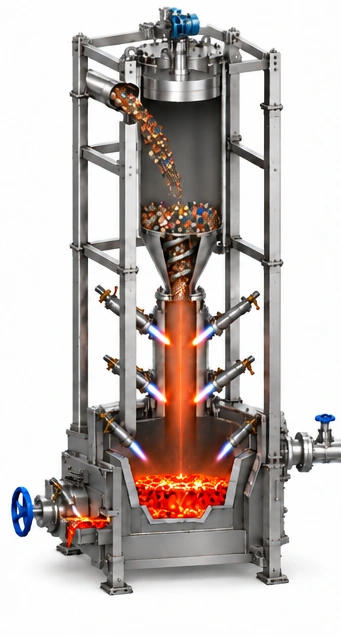
Prepared waste enters below the raised piston.
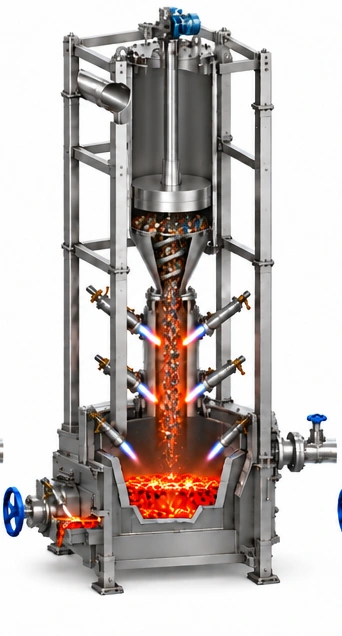
The piston descends while the screw rotates at a fixed height, feeding waste into IM-3.
04 / THE CONVERSION CORE
The plasma stage transforms the organic and mineral fractions along two distinct paths: gas for methane conversion, and vitrified mineral material.
Design gas temperature at the reactor outlet.
Month 0 Basic Design, section 4.4.2.
05 / ENGINEERING FOUNDATION
Bureau Veritas witnessed a KOH-based biogas-cleaning pilot test in September 2025. This component-process experience complements the PGMCC engineering programme. The 1,000 kg/h industrial design model provides a basis for project-specific performance targets and product specifications.
06 / PROJECT PARTNERS
Assess a methane pathway for a defined municipal waste stream, with feedstock preparation and site integration in the scope.
Define the gas specification, utility interfaces, process controls and validation programme around the intended application.
Evaluate the engineering basis and the milestones needed to progress from pilot development to an industrial project.
LET’S DEFINE YOUR PROJECT
Share your waste composition, annual wet-basis quantity, moisture analysis, site and intended methane use. We can then define the feedstock assessment, output specifications and validation scope.